




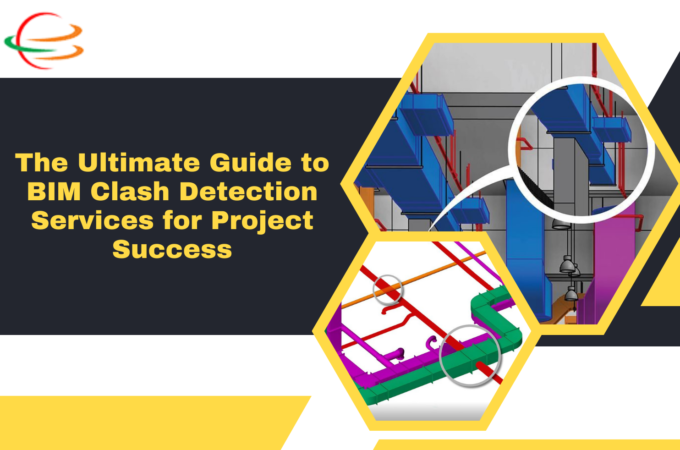
The building industry is under greater pressure than ever before to produce projects on time, within budget, and error-free. That’s where BIM Clash Detection Services have their place.
This proactive technique enables teams to detect and resolve conflicts in digital models before reaching the construction site. In doing so, it prevents delay, minimises rework, and facilitates more efficient collaboration among all disciplines.
If you’re a newcomer to clash detection or just want to enhance your existing workflows, this handbook explains all you need to know about its place in successful projects today.
What is BIM Clash Detection?
Fundamentally, clash detection is about making sure that various building systems can coexist in harmony. In a standard project,
Each of the architects, engineers, and contractors will create models of their own systems. When integrated into one model, clashes or “clashes” tend to occur.
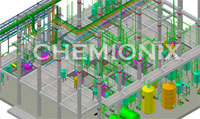
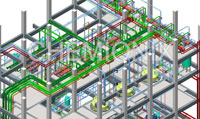
For instance, a ventilation duct could intersect a structural beam, or electrical conduits could cross over plumbing pipes.
BIM Clash Detection Services utilise specialised software to highlight these areas in the 3D world, enabling the team to resolve them electronically before building commencement.
Types of Clashes in BIM
Not all clashes are equal, and knowing their types allows the teams to resolve them better.
- Hard Clashes: Physical interferences, like a pipe through a beam.
- Soft Clashes: Clearance requirement issues, such as a lack of space around equipment for service access.
- Workflow Clashes: Scheduling issues when activities or trades conflict in ways that impact sequence.
Clash detection by addressing these problems early allows for design correctness and constructibility.
Why Clash Detection is Essential for Project Success
1. Cost and Time Savings
Construction mistakes are costly. Repairing a clash in the field commonly involves stopping work, procuring new materials, and rescheduling labourers.
Identifying these problems virtually with the aid of BIM modeling services avoids rework and minimises delays, leading to tremendous savings.
2. Enhanced Collaboration Across Teams
Projects have various stakeholders with diverse priorities. Clash detection establishes a common space,
In which architects, engineers, and contractors collaborate without any differences.
Everyone uses the same model to work, so communication becomes better and conflicts are resolved quickly.
3. Improved Safety and Compliance
Collisions can have a direct influence on safety. An incorrectly placed sprinkler or fire protection system could undermine building safety levels.
Sophisticated solutions such as 3D BIM fire protection modeling guarantee that essential systems are placed in the right spots and satisfy code compliance.
4. Improved Project Predictability
Developers and owners insist upon predictability with schedules and budgets.
By incorporating clash detection into your BIM drafting services, you feel more assured of project results and minimise uncertainty at construction time.
How Clash Detection Functions
The clash detection process normally occurs with a formal workflow:
Model Integration
Models from various disciplines, architectural, structural, and MEP, are integrated into a federated BIM model.
Inputs from CAD to BIM conversion services are often employed in this process for compatibility.
Clash Analysis
Automated checks are performed using software tools such as Navisworks or Revit to detect clashes. The output is recorded with comprehensive reports and visual indicators.
Review and Resolution
Clashes are reviewed by teams in coordination meetings, have responsibility assigned, and required changes made to the models.
Verification and Iteration
Revised models are checked again until conflicts are minimised, ensuring constructability before on-site implementation.
Benefits for Various Stakeholders
- Architects: Preserve their designs intact and coordinate smoothly with engineering inputs.
- Engineers: Confirm mechanical, electrical, and plumbing systems interact without conflict.
- Contractors: Get clean, clash-free plans that minimise site errors and facilitate efficient implementation.
- Owners: Have confidence in project completion, cost management, and enduring building performance.
Incorporating Clash Detection Into Your Workflow
For optimum effect, clash detection must not be done once. It must be incorporated continuously during the design and pre-construction stages. This involves:
- Conducting periodic clash detection checks during design development.
- Employing BIM modeling services to constantly update models.
- Recruiting BIM drafting services to generate precise, coordinated drawings.
- Utilising CAD to BIM conversion services for existing files to ensure consistency.
This continuous practice guarantees smoother project realisation and better collaboration among teams.
Collaborate with Chemionix for Effortless BIM Support
Clash detection is a technical-sounding process, but its effect is clear: fewer errors, quicker timelines, and improved outcomes.
You require a partner that can offer both technical and industry knowledge to work in concert with your project objectives.
Chemionix is your expert in BIM clash detection solutions, BIM modeling solutions, and full-cycle support from CAD to BIM conversion solutions to 3D BIM fire protection modeling. Your models are clash-free, code-compliant, and ready for construction with the assurance of our experts.
Don’t let the risks of a project hold you back. Join forces with Chemionix today and construct with confidence. Contact us to learn about BIM solutions for your next project.
